A 15-Minute Daily Yoga Routine for Beginners
A simple 15 minute yoga routine for beginners you can do every morning. Gentle poses, clear cues, and breathing, even with zero flexibility.
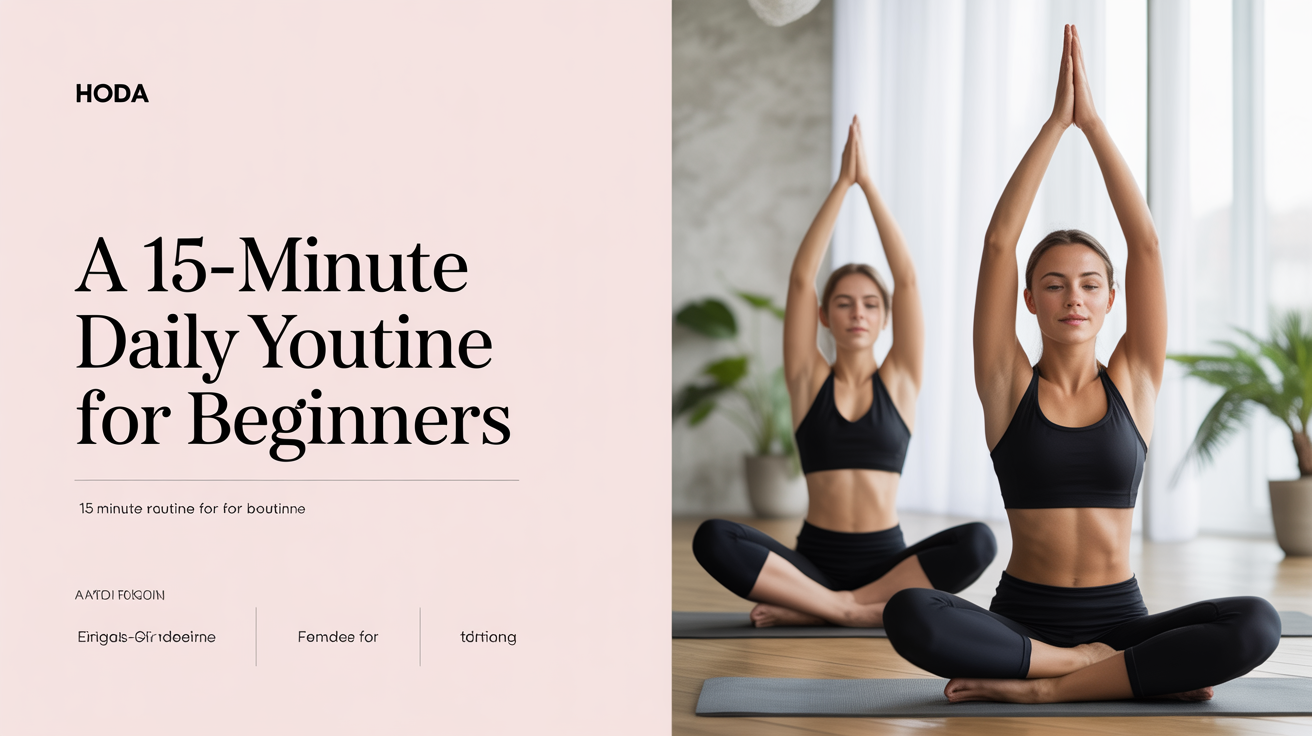
Fifteen minutes is enough. You don't need an hour, a fancy studio, or the ability to touch your toes. A short daily yoga session done with attention will do more for a stiff, sleepy body than a long session you only manage twice a month.
This is a full 15 minute yoga routine you can run before coffee, after work, or whenever you have a small gap. Every pose has a beginner-friendly option, and you can move through the whole thing on a towel if you don't own a mat yet. Move gently, keep breathing, and back off anything that pinches.
Before You Start
Find a clear spot about the size of a beach towel. Bare feet, comfortable clothes you can bend in, and a wall nearby for balance. If you have tight hips or a sore lower back, keep a folded blanket or a couple of firm pillows handy to sit on.
A quick word on safety. Yoga should feel like a stretch, not a strain. Sharp, pinching, or electric pain is your signal to ease out right away. Slow ache in a tight muscle is usually fine; pain in a joint is not. If you're pregnant, recovering from an injury, or managing a health condition, check with your doctor before starting. This article is educational, not medical advice.
One more thing: breathe through your nose, slow and steady, in and out. The breath is what turns stretching into yoga. If you ever notice you're holding your breath, you're probably pushing too hard.
The Routine at a Glance
Here's the whole 15 minute yoga for beginners sequence. Times are a guide, not a rule. If you want to linger somewhere, do.
| # | Pose | Time | What it's for |
|---|---|---|---|
| 1 | Seated breathing | 1 min | Settle in, find the breath |
| 2 | Cat-Cow | 2 min | Wake up the spine |
| 3 | Child's Pose | 1.5 min | Release the back and hips |
| 4 | Downward Dog | 1.5 min | Stretch hamstrings and shoulders |
| 5 | Low Lunge (both sides) | 3 min | Open tight hip flexors |
| 6 | Standing Forward Fold | 1.5 min | Lengthen the whole back body |
| 7 | Bridge | 2 min | Gentle backbend, glutes |
| 8 | Reclined twist (both sides) | 1.5 min | Wring out the spine |
| 9 | Rest | 1 min | Let it all land |
That's roughly fifteen minutes. Set a timer if you tend to rush, or just flow at your own pace.
The Poses, Step by Step
1. Seated Breathing (1 minute)
Sit cross-legged on the floor. If your knees float way up or your back rounds, sit on the edge of a folded blanket or a cushion so your hips are higher than your knees. Rest your hands on your thighs. Close your eyes if that feels okay. Take ten slow breaths, letting each exhale be a little longer than the inhale. This is your transition from "the day" into "the practice."
2. Cat-Cow (2 minutes)
Come to hands and knees. Wrists under shoulders, knees under hips. As you inhale, drop your belly, lift your chest and tailbone, and look slightly forward (Cow). As you exhale, round your spine toward the ceiling and tuck your chin (Cat). Move with your breath, one shape per inhale and exhale. This is the best way to warm up a stiff spine, and it feels great first thing in the morning.
Common mistake: cranking the neck back hard in Cow. Keep the movement gentle and let your spine, not your neck, do the work.
3. Child's Pose (1.5 minutes)
From hands and knees, bring your big toes together, widen your knees, and sit your hips back toward your heels. Walk your hands forward and rest your forehead on the floor. If your hips don't reach your heels, that's normal; tuck a cushion between your calves and thighs to fill the gap. Breathe into your back. This is your rest pose. Any time something feels like too much during the routine, you can come back here.
4. Downward-Facing Dog (1.5 minutes)
From hands and knees, tuck your toes and lift your hips up and back into an upside-down V. Bend your knees generously. A common beginner trap is forcing the heels to the floor with straight legs, which just yanks on tight hamstrings and rounds the back. Instead, keep a soft bend, lengthen your spine, and let your heels hover. Pedal your feet if it feels good. Your hamstrings will loosen over weeks, not in one session.
5. Low Lunge (3 minutes, both sides)
Step your right foot forward between your hands and lower your back knee to the floor (pad it with a blanket if it's tender). Let your hips sink forward and down. You should feel a stretch across the front of your back leg's hip. Most of us sit too much, and this is the pose that undoes some of that tightness. Hold for about 90 seconds, breathing slowly, then switch sides. Keep your front knee stacked over your ankle, not drifting past your toes.
6. Standing Forward Fold (1.5 minutes)
Step or walk your feet up to your hands and stand. Feet hip-width apart. Soften your knees a lot, then hinge from your hips and fold forward, letting your head and arms hang. Hold opposite elbows and sway side to side if you like. Bent knees are not cheating here; they protect your lower back and let the stretch reach your hamstrings safely. To come up, bend your knees more and roll up slowly so you don't get dizzy.
7. Bridge (2 minutes)
Lie on your back, knees bent, feet flat and hip-width apart, close enough that your fingertips graze your heels. Press into your feet and lift your hips. Keep your knees pointing forward, not splaying out. This gently opens the front of your body and strengthens your back and glutes, which is useful after a day of sitting. Lower down slowly. You can repeat it two or three times rather than holding one long lift.
8. Reclined Twist (1.5 minutes, both sides)
Still on your back, hug both knees in, then let them drop to the right while you turn your head to the left. Keep both shoulders heavy on the floor. Don't force your knees all the way down; let gravity do it over time. This twist feels like a quiet reset for the spine. Hold, breathe, then switch sides.
9. Rest (1 minute)
Stretch your legs out, arms by your sides, palms up. Close your eyes and do nothing for a full minute. This pose looks like the easy one and is secretly the hardest, because your busy brain wants to skip it. Don't. It's where your nervous system catches up with the work you just did.
Making It a Daily Habit
The hard part of any quick yoga routine isn't the poses, it's showing up. A few things that genuinely help:
- Anchor it to something you already do. Right after you brush your teeth, or the moment you close your laptop. Habits stick when they hang off an existing one.
- Leave the mat out. A rolled-up mat in the closet is a mat you'll skip. A visible one is an invitation.
- Lower the bar on bad days. Five minutes of Cat-Cow and Child's Pose still counts. Short daily yoga beats the perfect session you keep postponing.
- Don't chase flexibility. Notice how your back feels, how your breathing slows. Progress in yoga is quiet and shows up over weeks.
If you want the deeper version of the habit question, see our guide on building a home yoga practice you'll actually keep. It pairs well with this routine.
Morning, Midday, or Evening?
Any time works, but they feel different. Morning practice wakes up a stiff body and tends to be the easiest to protect from a busy schedule. Evening practice runs better as a slow wind-down, so soften the standing poses and linger longer in the twist and final rest. Pick the slot you're most likely to actually keep, then stay consistent for a couple of weeks before judging it.
Adjusting the Routine to You
This sequence is a starting point, not a cage. If you have cranky wrists, do Cat-Cow on your forearms and skip Downward Dog in favor of a longer Child's Pose. Tight hamstrings? Bend your knees more everywhere and use the seated cushion. As you get comfortable, you can start to understand the logic of why these poses are ordered the way they are; our piece on sequencing a balanced beginner routine breaks that down.
You also don't need to buy anything. A folded towel, a couple of firm books, and a wall cover almost every prop a beginner needs. If you're curious about what's worth using and what you can fake, the rundown on yoga props and household stand-ins is a practical place to start.
FAQ
Is 15 minutes of yoga a day actually enough?
Yes, especially as a beginner. A consistent 15 minute yoga routine does more for mobility and stress than a long session you rarely repeat. Frequency beats duration. You can always add time later once the habit holds.
What if I can't touch my toes or sit cross-legged comfortably?
That's completely normal and not a problem. Bend your knees in every forward fold, and sit up on a cushion or blanket for seated poses. Flexibility is the result of practicing, not a requirement to begin. The routine is designed to meet a stiff body where it is.
Do I need a yoga mat to start?
No. A non-slip rug or a folded towel works fine for these poses. A mat is more comfortable and grippier, so it's a nice upgrade once you know you'll stick with it, but it's not a barrier to starting today.
When will I notice a difference?
Most beginners feel a little looser and calmer right after the very first session. Lasting changes in flexibility and strength usually show up after two to three weeks of near-daily practice. Keep it gentle and consistent, and let the slow progress be the point.
Should I do this routine if I'm sore from yesterday?
Light soreness is fine; gentle movement often helps it. But if a specific spot feels sharp or strained, skip the poses that load it and spend more time resting. Yoga should never make a real injury worse.