Yoga Props for Beginners (and Household Stand-Ins)
What yoga props for beginners actually do, which ones matter, and the household stand-ins that work just as well when you're starting out.
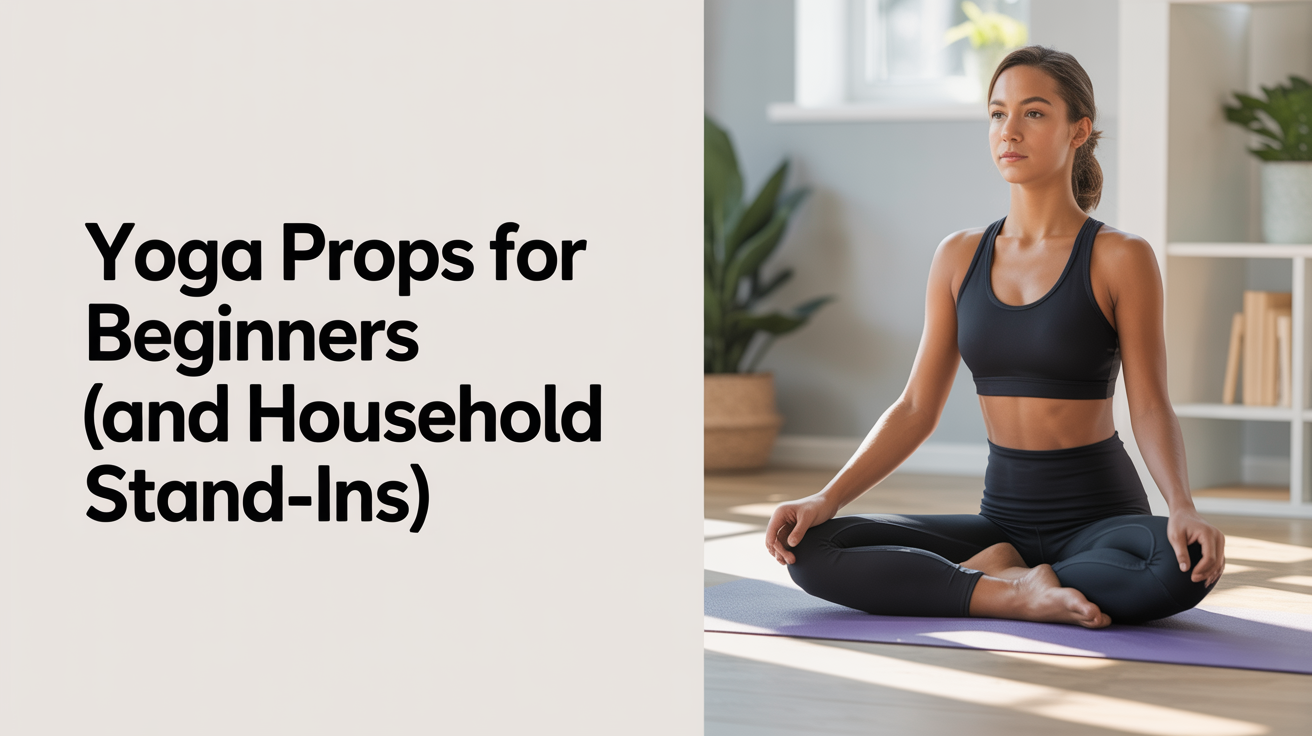
Walk into a yoga class and you'll see people reaching for foam bricks, looping straps around their feet, and stacking blankets under their hips. If you're new, it can look like you need a shopping cart of gear before you can even sit down. You don't.
Props exist to bring the floor closer to you, not to test your flexibility. They make poses fit your body instead of asking your body to contort into a pose. And almost every one of them has a free version sitting in your closet right now.
What props actually do
Here's the part nobody tells beginners: a prop isn't a crutch or a sign you're behind. It's a tool that closes the gap between where your hand can reach and where the ground happens to be.
Take a standing forward fold. If your hamstrings are tight (most beginners' are), your fingertips might hover six inches above the floor. You have two choices. You can round your back and strain to touch down, or you can put a block under each hand and let the floor "rise" to meet you. The second version is safer, calmer, and actually stretches the right muscles instead of yanking your lower back.
That's the whole job of a prop:
- Height so you don't have to fold or reach further than your range allows
- Support so muscles can relax instead of bracing to hold you up
- Length so a tight shoulder or hamstring doesn't cut a pose short
- Padding so bony knees, hips, and ankles aren't grinding into a hard floor
When you frame it that way, the answer to do you need yoga props gets simple. You don't need to buy anything. You do need height, support, length, and padding, and you can get all four for free today.
The core props, ranked by how much they help
If you eventually want to buy gear, here's the order I'd spend money in. Most beginners never need past the first two.
| Prop | What it's for | Buy it if | Free stand-in |
|---|---|---|---|
| Block | Raising the floor in folds, lunges, balance | You practice 2+ times a week | Thick hardcover book or sturdy shoebox |
| Strap | Reaching feet, opening shoulders | Tight hamstrings or shoulders | Belt, dog leash, long scarf, towel |
| Blanket | Cushioning, sitting taller, gentle restorative | Hard floors hurt your knees/hips | Folded bath towel or actual blanket |
| Bolster | Restorative and supported poses | You love slow, relaxing practice | Couch cushion or rolled-up duvet |
| Mat | Grip and cushioning underfoot | You slide on your floor | A rug, carpet, or large towel |
Yoga blocks for beginners
If you buy one thing, make it a block. Yoga blocks for beginners are the single most useful piece of equipment because they show up in so many poses: under your hands in a forward fold or low lunge, under your bottom hip in a seated twist, under your sacrum for a supported bridge.
A foam block has three heights depending on which side you rest it on. Tall side for the most support, flat side for the least. Start with the tallest and lower it over weeks as you loosen up. There's no prize for using the short side.
The household version works fine. A fat hardcover book, two if you need the height, or a shoebox packed so it won't crush. The only thing to check is stability: it shouldn't wobble or slide when you put weight on it.
Yoga strap alternatives that already live in your house
A strap is just a length of something you can't accidentally pull longer. You loop it around a foot to reach in a seated forward fold, or hold it between your hands to open tight shoulders without forcing the joint.
You almost certainly own a good substitute. Useful yoga strap alternatives include:
- A bathrobe tie or fabric belt (my personal favorite, soft and long)
- A regular leather or canvas belt for shorter reaches
- A dog leash, especially the flat nylon kind
- A long scarf or a rolled bath towel held at both ends
The one rule: use something that won't stretch under tension. A bungee cord or a stretchy resistance band defeats the purpose, because the whole point is a fixed length that lets you ease into a stretch with control.
Putting stand-ins to work, pose by pose
Concrete examples help more than a gear list. Here's how the household versions slot into common beginner poses.
| Pose | What feels hard | Stand-in fix |
|---|---|---|
| Standing forward fold | Hands won't reach the floor | A book under each hand |
| Seated forward fold | Can't grab your feet | Belt or scarf looped around the soles |
| Low lunge | Back knee hurts on the floor | Folded towel under the knee |
| Easy seated pose | Slumping, lower back aches | Sit on the edge of a folded blanket |
| Reclined twist | Knees float, can't relax | Cushion between or under the knees |
| Supported bridge | Lower back works too hard | Stack a book or two under your sacrum |
Notice the pattern. Every fix either raises the floor, cushions a bony point, or gives you something to hold onto. Once you see that, you can improvise a prop for almost any pose without buying a thing.
If you want to see how these fit into a real flow, a short daily routine for beginners is a good place to try a block and a strap in context rather than in isolation.
A few safety notes that matter
Props make poses safer, but they don't override your body's signals. Move into every stretch slowly and back off the second you feel sharp, pinching, or shooting pain. A deep stretch should feel like a strong, breathable sensation, never a warning sign. Keep breathing the whole time; if you're holding your breath, you've probably gone too far.
When you set up a stand-in, test it before you trust it with your weight. A book that slides on a wood floor or a couch cushion that compresses to nothing can put you off balance. Press on it first.
This is general guidance, not medical advice. If you're pregnant, recovering from an injury, or managing a health condition, check with your doctor before starting a new practice and let them weigh in on which poses to skip.
Building a kit without overbuying
The trap for new students is buying a full prop set, using it twice, and watching it gather dust. Spend on gear the way you'd earn it. Practice with household stand-ins for a few weeks first. If you find yourself reaching for the same book-as-block every session, that's your signal to buy a real block, and you'll know exactly why.
Two blocks and one strap will carry you through years of practice. Add a blanket if your floors are hard. Everything past that is comfort, not necessity. Getting consistent matters far more than getting equipped, which is really the heart of building a home practice you'll actually keep.
When you do start arranging poses into a session, props quietly make a balanced beginner sequence more accessible, since you can support the harder shapes instead of skipping them.
FAQ
Do I really need to buy yoga props as a beginner?
No. Household stand-ins cover everything a starter kit does. Books work as blocks, a belt or scarf works as a strap, and a folded towel works as a blanket. Buy real gear only once you're practicing regularly and know which props you actually reach for.
What's the difference between a foam block and a cork block?
Foam is light, soft, and cheap, which makes it the right first block for most people. Cork is heavier and firmer, so it feels more stable under full body weight but can be hard against bony areas. Beginners are well served by foam.
Can I use a resistance band instead of a yoga strap?
It's not ideal. A strap works because its length is fixed, letting you ease into a stretch with control. A stretchy band gives way under tension, so you lose that steady support. A non-stretch belt, leash, or scarf is a better swap.
How do I know if a household stand-in is safe to use?
Test it before you load it. Press down on a book-block or step gently onto a folded towel and make sure it doesn't slide, wobble, or compress to nothing. If it shifts under light pressure, it'll shift under your full weight, so pick something sturdier.
Will using props slow down my progress?
The opposite. Props let you hold poses with good alignment instead of straining, so the right muscles actually work and stretch. You'll often progress faster with support than without it, and you lower the props as your range improves.