Gentle Yoga for Stress and Anxiety (Poses and Breathing)
Learn calming yoga poses and breathing techniques that many beginners find helpful for managing stress. Practical, beginner-friendly guidance with safety in...
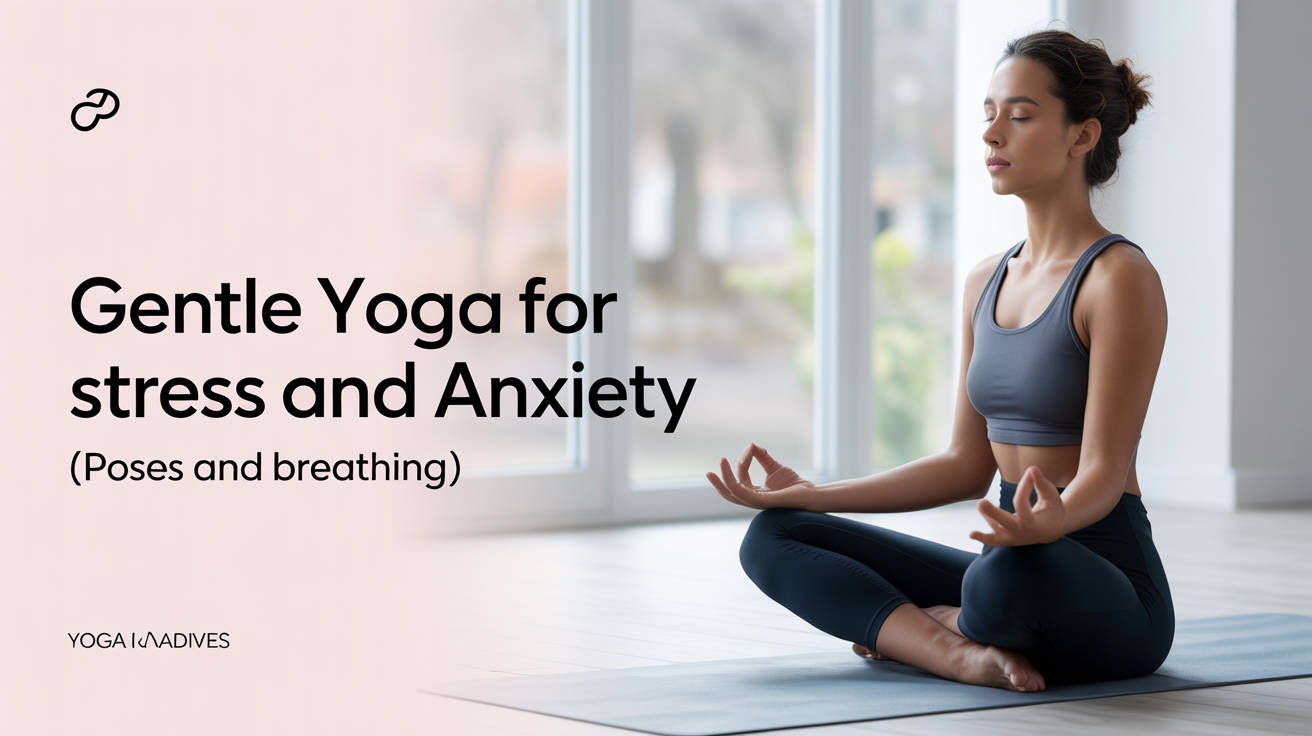
When stress piles up, your body tends to hold onto it. Shoulders creep toward your ears, breathing gets shallow, and the mind keeps circling the same worries. Gentle yoga gives you something practical to do with that tension: you move deliberately, breathe on purpose, and give your nervous system a chance to settle.
This guide covers a handful of calming poses and simple breathing practices well-suited to beginners. Nothing here requires flexibility, prior experience, or special equipment. All you need is a quiet spot and a few minutes.
A quick note before we start: yoga can be a supportive part of a stress-management routine, and many people find it genuinely helpful. It is not a treatment for anxiety disorders or a substitute for professional care. If anxiety is persistent, severe, or affecting daily life, please talk with a doctor or mental-health professional.
Why Gentle Yoga Can Help with Stress
Stress activates the sympathetic nervous system, the part responsible for the fight-or-flight response. Slow, controlled movement paired with deliberate breathing can help shift the balance toward the parasympathetic branch, sometimes called the rest-and-digest state.
Three things tend to make a yoga session feel calming rather than stimulating:
- Slow pace. Moving between poses without rushing signals safety to the nervous system.
- Breath focus. Paying attention to each inhale and exhale interrupts the mental loop of worry.
- Floor-based shapes. Poses that bring you close to the ground tend to feel grounding rather than activating.
You do not need to achieve any particular shape. The physical position is mostly a way to anchor your attention while you breathe.
Calming Poses to Try
Each pose below can be held for 5 to 10 slow breaths. If anything causes sharp or persistent pain, ease out of it. Props like folded blankets or cushions are encouraged, not optional.
Child's Pose (Balasana)
Kneel on the floor with your big toes touching and knees hip-width apart or wider. Fold forward, extending your arms in front of you or resting them alongside your legs. Let your forehead rest on the mat or on a folded blanket.
Child's Pose is a natural resting shape. It gently lengthens the lower back, takes the spine out of any held tension, and gives you a surface to feel your breath pressing against your belly. Stay as long as feels comfortable.
Legs Up the Wall (Viparita Karani)
Sit sideways next to a wall, then swing your legs up as you lower your back to the floor. Your legs rest against the wall, your back is flat, and your arms can settle by your sides with palms facing up.
This mild inversion encourages blood to drain from the legs and feet, which many people find deeply relaxing. A folded blanket under the hips adds comfort. Stay for 5 to 15 minutes if you like.
Reclined Bound Angle (Supta Baddha Konasana)
Lie on your back. Bring the soles of your feet together and let your knees fall open to the sides. Place your hands on your belly or let your arms rest to the sides.
If the inner thighs or hips feel strained, support each knee with a rolled blanket or block. The pose opens the hips passively and is a useful shape for slow breathing.
Seated Forward Fold (Paschimottanasana)
Sit on the floor with legs extended. On an exhale, hinge forward from the hips, reaching toward your feet. Hold your shins, ankles, or feet, wherever you comfortably reach.
Do not force the fold. The goal is a gentle release in the back of the legs and spine, not reaching a specific depth. Sitting on a folded blanket can make the fold easier if the hamstrings are tight.
Supine Spinal Twist
Lie on your back, draw your right knee toward your chest, then guide it across your body to the left while your right arm extends to the side. Turn your head to look right if that feels comfortable for your neck.
Hold 5 to 8 breaths, then switch sides. Spinal twists help release tension across the back and shoulders. Keep the movement easy, never forcing the knee lower than it wants to go.
Breathing Practices for Calming the Mind
Movement is only half the picture. Breath is where much of the calming work actually happens.
Extended Exhale Breathing
Stress tends to shorten the exhale. Deliberately lengthening it can help slow the heart rate and ease the feeling of urgency.
Try inhaling for a count of 4 and exhaling for a count of 6 or 8. Over a few minutes, you may notice your shoulders drop and your thoughts slow. For a full introduction to breathing basics, see Yoga Breathing for Beginners: A Simple Introduction to Pranayama.
Belly Breathing (Diaphragmatic Breathing)
Most stressed breathers use mainly the chest. Shifting breath down into the belly encourages a fuller, slower breathing pattern.
Place one hand on your chest and one on your belly. Breathe so that the belly hand rises first and the chest hand stays relatively still. Even a few minutes of this can feel noticeably calming. A step-by-step walkthrough is available in How to Do Diaphragmatic (Belly) Breathing.
Alternate Nostril Breathing (Nadi Shodhana)
This classic pranayama technique involves alternating between the left and right nostrils in a controlled pattern. Many practitioners find it particularly effective for quieting a busy mind.
It takes a few sessions to feel natural, but the basic pattern is straightforward and the effects tend to be noticeably settling. Full instructions are at Alternate Nostril Breathing (Nadi Shodhana) for Beginners.
A Simple 15-Minute Stress-Relief Sequence
| Step | What to Do | Duration |
|---|---|---|
| 1 | Belly breathing lying down | 3 minutes |
| 2 | Reclined Bound Angle | 2 minutes |
| 3 | Supine Spinal Twist (both sides) | 3 minutes |
| 4 | Child's Pose | 2 minutes |
| 5 | Legs Up the Wall | 5 minutes |
Skip any pose that does not feel right for your body on a given day. The sequence is a suggestion, not a rule.
Frequently Asked Questions
Do I need to do yoga every day for it to help with stress?
Not necessarily. Even one or two sessions a week can help you build familiarity with the poses and breathing so that when you need a calming tool, it is already available to you. Consistency tends to produce better results over time, but there is no single required frequency.
What if I feel more anxious during yoga instead of less?
This happens sometimes, and it is worth taking seriously. Certain poses, especially chest openers or inversions, can feel activating rather than calming for some people. If a pose feels uncomfortable or makes anxiety worse, come out of it and try a simpler shape like Child's Pose or just lying flat on your back. If this happens consistently, speaking with a yoga teacher who has experience with anxiety may be helpful.
Can yoga replace therapy or medication for anxiety?
No. Yoga can support overall wellbeing and be a useful part of a broader self-care routine. For clinical anxiety, professional treatment through a therapist, counselor, or psychiatrist is important. Yoga and professional care are not mutually exclusive, but one should not replace the other.
Do I need a yoga mat?
A mat helps with grip and cushioning, but you can practice on a carpet or even on a folded blanket to start. If you find that you want to practice regularly, a basic mat is a worthwhile investment. You do not need to spend much.
How do I know if I am doing the poses correctly?
In gentle, floor-based yoga, "correctly" mostly means: you can breathe freely, you feel some mild stretch but no sharp pain, and you can hold the shape for several breaths without straining. If you are uncertain, a beginner class with a qualified instructor, even a short series, can help you learn the fundamentals with feedback.