How to Do Cat-Cow for a Healthy, Mobile Spine
Learn how to do Cat-Cow step by step, with breath cues, beginner mistakes to avoid, and easy modifications for a healthier, more mobile spine.
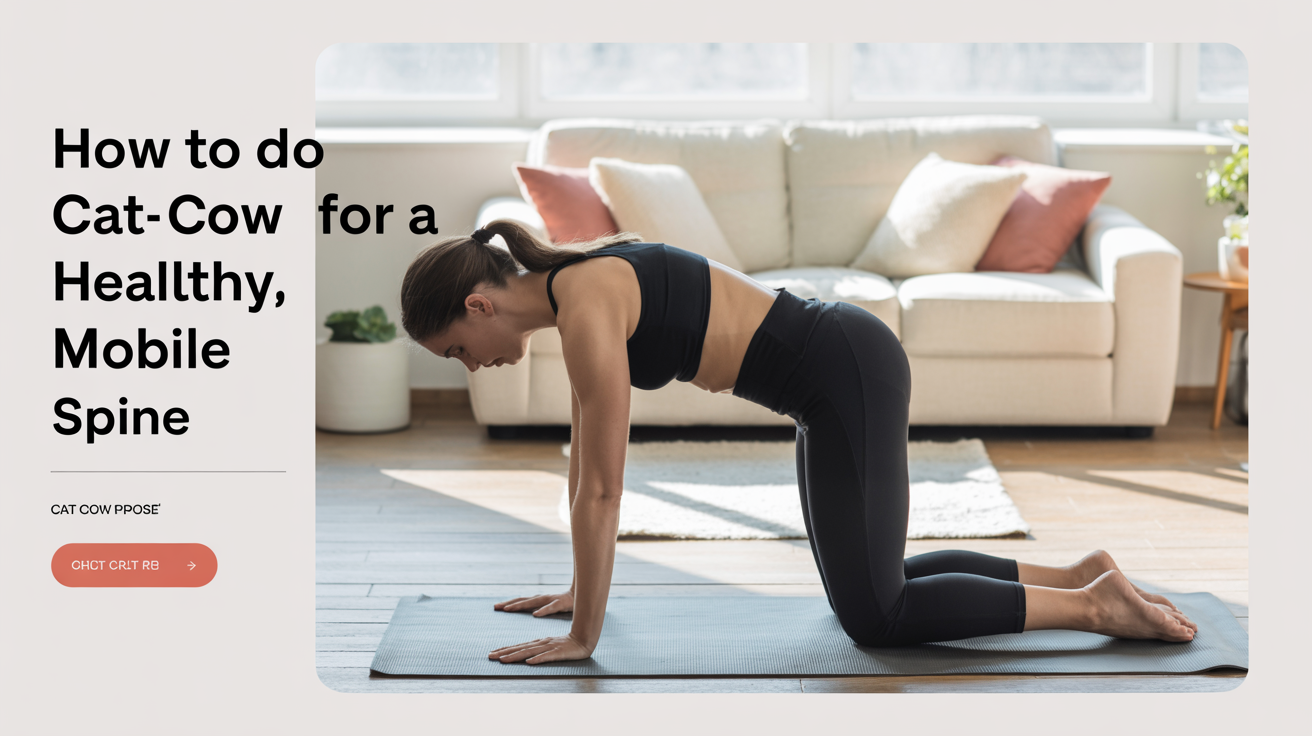
If you sit most of the day and your back feels stiff by evening, Cat-Cow is one of the kindest things you can do for it. You move on your hands and knees, rounding and arching your spine in time with your breath. There's no flexibility requirement and no risk of falling over, which makes it a great first pose.
Cat-Cow pose is two shapes that flow together: Cat (a rounded back) and Cow (a gentle arch). In Sanskrit it's called Marjaryasana Bitilasana. Teachers reach for it constantly because it warms up the whole spine, wakes up your core, and teaches you to link movement with breathing. That last skill carries into almost every pose you'll learn later.
What Cat-Cow Actually Does
Your spine is built to move in several directions: forward, back, side to side, and twisting. Sitting in a chair lets it do almost none of that for hours at a stretch. Cat-Cow takes your spine through flexion (rounding) and extension (arching), which is the most basic movement it craves.
A few things happen when you practice it regularly:
- The small muscles along your spine get a gentle wake-up call.
- Your abdominals switch on as you round into Cat, which most people don't expect.
- Your neck and tailbone, the two ends of the spine, learn to move with the rest instead of staying locked.
- You start noticing your breath, because the pose is paced by inhales and exhales.
It's why Cat-Cow shows up at the start of so many classes as a spinal warm up yoga staple. Three or four slow rounds and your back feels less like a board and more like something that bends.
How to Do Cat-Cow, Step by Step
Set yourself up on a mat or a folded blanket on the floor. If your knees are sensitive, double the padding under them.
- Start on all fours. Put your wrists directly under your shoulders and your knees under your hips. Spread your fingers wide and press into the whole hand, not just the heel of the palm. Your back should be flat, like a tabletop, and your gaze down at the floor.
- Find a neutral spine first. Before you move, take one breath here. This flat, level position is your home base.
- Move into Cow on an inhale. Breathe in and let your belly drop toward the floor. Lift your chest and your tailbone, and look slightly forward. Your back makes a gentle dip. Keep the lift coming from your whole spine, not by cranking your head back.
- Move into Cat on an exhale. Breathe out and press the floor away with your hands. Round your back toward the ceiling like a scared cat, tuck your tailbone under, and let your head relax down so you're looking toward your thighs.
- Keep flowing. Inhale to Cow, exhale to Cat. Let the breath set the speed, so the movement is slow and even.
- Do 5 to 10 rounds. One round is one Cow plus one Cat. Stop while it still feels good, not when you're bored or tired.
The whole thing should feel like a wave moving through your spine. If you can only manage a small range at first, that's completely fine. The motion matters more than the size of it.
Where to feel it
In Cow, you'll feel a light opening across your chest and the front of your torso. In Cat, you'll feel a stretch across your upper back and between your shoulder blades, and your abs working a little to pull your navel up. You should never feel a sharp or pinching sensation in your lower back or neck. If you do, make the movement smaller and slower, or back off entirely.
Breathing and Pacing
The breath is half the pose. Matching movement to breath is what turns Cat-Cow from a stretch into actual yoga, and it builds a habit you'll use everywhere else.
Here's the simple pattern:
| Breath | Movement | What it looks like |
|---|---|---|
| Inhale | Cow | Belly drops, chest and tailbone lift, gaze forward |
| Exhale | Cat | Back rounds up, tailbone tucks, head releases down |
Breathe through your nose if you can, and let each breath be long and quiet. A good pace is roughly one full breath per shape, so a single round takes maybe six to eight seconds. If you find yourself rushing, you're probably holding your breath. Slow down and let the inhale and exhale lead.
Common Beginner Mistakes
None of these will hurt you, but fixing them makes the pose far more useful.
- Only moving the lower back. People often arch and round just the lumbar area and leave the upper back and neck stiff. Try to let the wave travel all the way up to the base of your skull.
- Cranking the neck. In Cow, lifting the chin too hard squeezes the back of the neck. Lift your chest more and your chin less.
- Forgetting the hands. Letting your weight sink into your wrists strains them. Press evenly through your fingers and palms to spread the load.
- Holding the breath. If you catch yourself frozen mid-pose, you've stopped breathing. The breath is the metronome.
- Going too fast. Speed turns it into a workout instead of a warm-up. Slow is the point.
If your wrists complain no matter what, come down onto your forearms, or make fists and balance on your knuckles to keep the wrists straight.
Easy Modifications
Cat-Cow adapts to almost any body. A few options:
- Sensitive knees: kneel on a folded blanket, or do the whole thing seated in a chair instead (round and arch your back while sitting tall).
- Sore wrists: drop to your forearms, propping your chest on a low block or cushion.
- Pregnancy: the all-fours position is usually comfortable, but keep the movements small and gentle, skip any deep belly drop, and check with your doctor or midwife first.
- More warmth: add small side-to-side movements, swaying your hips toward one wrist then the other, after your rounds.
Speaking of warming up, Cat-Cow pairs beautifully with the other early poses you'll meet. It's a natural lead-in to standing work like Mountain Pose, and it preps your shoulders and spine nicely before something more demanding like Downward-Facing Dog. If you're just getting started, it sits comfortably among the foundational poses every beginner should learn.
One general note: yoga is exercise, and this is educational guidance rather than medical advice. If you're pregnant, recovering from an injury, or managing a back or neck condition, talk to your doctor before adding new movement.
A Simple Way to Practice It
You don't need a long session to benefit. Try this short routine in the morning or before bed:
- Come to all fours and find neutral spine.
- Take three quiet breaths to settle.
- Move through 8 rounds of Cat-Cow, slow and breath-led.
- Add a few hip sways side to side.
- Sit back toward your heels for a breath or two to finish.
That's about three minutes. Do it daily for a week and pay attention to how your back feels getting out of a chair. Most people notice the difference quickly, which is the best reason to keep going.
FAQ
How many times should I do Cat-Cow?
Five to ten rounds is plenty for a warm-up. If your back is especially stiff, you can do a couple of short sets through the day. Quality and slowness matter more than racking up reps.
Is Cat-Cow safe if I have a bad back?
For many people with general stiffness or mild aches, the gentle rounding and arching feels good and helps. Keep the range small and stay out of any sharp pain. If you have a diagnosed back condition, a disc issue, or recent injury, check with your doctor or physical therapist before practicing.
What's the difference between Cat and Cow?
Cat is the rounded, scared-cat shape you make on an exhale, with your back curved up toward the ceiling. Cow is the gentle dip you make on an inhale, belly dropping and chest lifting. Together they're called Marjaryasana Bitilasana, and you flow between them with your breath.
Should I inhale or exhale first?
Start in neutral, then inhale as you move into Cow and exhale as you move into Cat. Linking the inhale to the arch and the exhale to the round is the standard pattern, and it's worth getting into the habit early.
Can I do Cat-Cow if I can't get on the floor?
Yes. Sit tall in a chair with your feet flat, hands on your thighs. Inhale and arch your back, lifting your chest, then exhale and round forward. It's the same spinal motion without any weight on your wrists or knees.