How to Do Triangle Pose (Trikonasana) With Proper Alignment
Learn how to do triangle pose step by step, with front foot and hip alignment, a block modification, common mistakes, and safety notes for beginners.
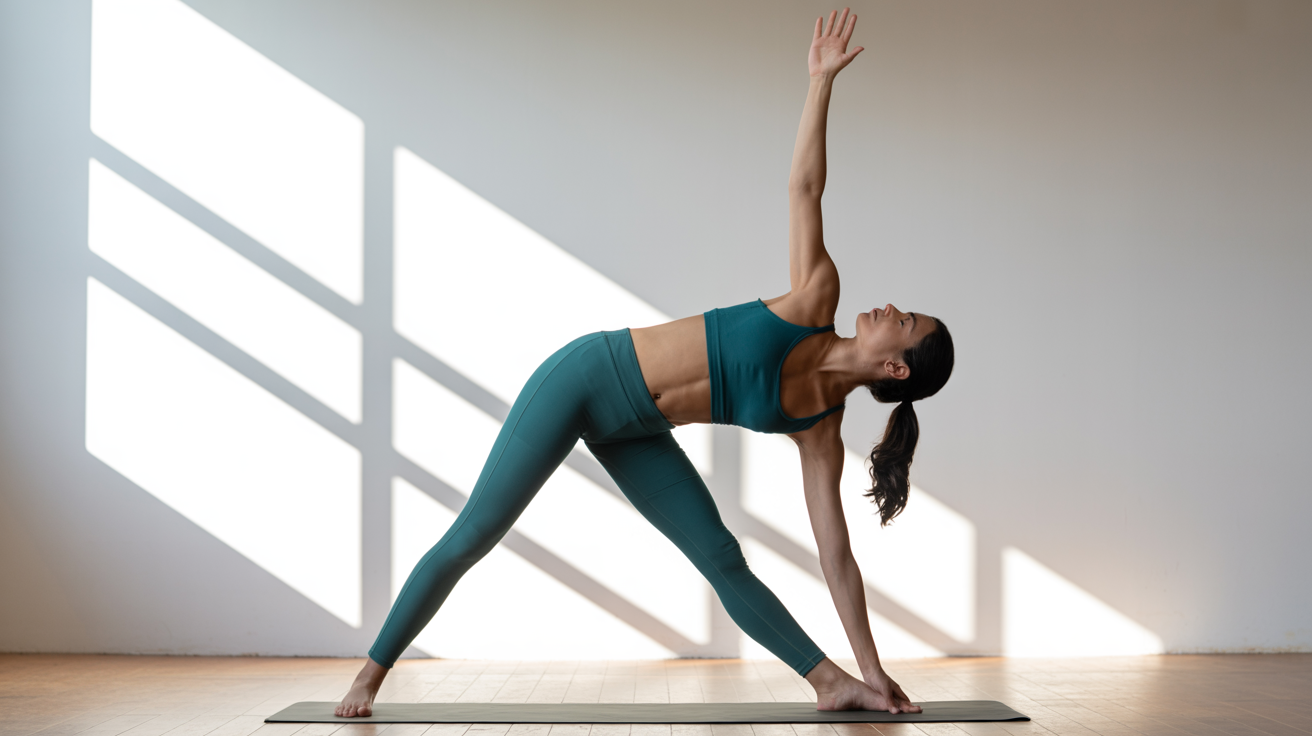
If you have ever wondered how to do triangle pose without your front knee wobbling or your top shoulder creeping forward, you are not alone. Trikonasana looks simple from across the room: a wide stance, a straight front leg, one arm reaching down and one reaching up. In practice it asks your hips, hamstrings, and shoulders to do several things at once, and most beginners end up folding at the waist instead of hinging from the hip. Once you understand the setup piece by piece, the pose stops feeling like a balancing act and starts feeling like a long, steady stretch. This guide walks through the stance, the alignment, the common mistakes, and a simple modification for anyone who can't reach the floor yet.
Setting Up the Wide-Legged Stance
Start standing at the top of your mat, feet together, the same way you would for mountain pose. From there, step your feet three to four feet apart, roughly the length of one leg. A wider stance gives you more room to hinge; a narrower one is easier to balance in, so adjust based on your height and how steady you feel.
Turn your right foot out so the toes point toward the top of the mat, a full 90 degrees. Your left foot, the back foot, turns in slightly, somewhere around 15 to 30 degrees. This small inward angle keeps your back hip from collapsing outward and gives your back leg something solid to press into.
Line your front heel up roughly with the arch of your back foot. Some teachers prefer heel-to-heel alignment instead, and either is fine as long as your stance feels stable rather than like a tightrope. Press evenly through both feet before you move into the tilt. This is the same foundational stance you'll recognize from warrior I and warrior II, just without the bent front knee.
Hip and Shoulder Alignment: The Part Everyone Rushes
This is where triangle pose is won or lost. With your feet set, square your hips and torso so they face the long edge of your mat, the same direction your front foot is pointing. Reach your arms out to the sides at shoulder height, palms down, so your body forms a wide T shape.
Now hinge from your front hip, not your waist. Keeping your legs straight (a soft bend in the front knee is fine if your hamstrings are tight, but avoid locking it hard), tip your torso sideways over your front leg, as if you were lowering yourself toward a wall just past your foot rather than folding straight down toward it. Your back hip will want to roll forward as you tilt; resist that and keep both hip points facing the side of the mat as long as you comfortably can.
Your front hand comes down toward your shin, ankle, or a block placed beside your front foot. Very few people can rest their palm flat on the floor without rounding their spine to get there, so don't chase the floor. Let your back arm float up toward the ceiling, stacking directly over the front one, so someone standing at your side would see one straight line running from your bottom hand through your shoulders to your top fingertips. Turn your head to look up at your top hand only if your neck is comfortable doing so; otherwise keep your gaze forward or down.
Common Triangle Pose Mistakes and How to Fix Them
Collapsing the front knee
The most common issue is letting the front knee cave inward toward the midline as you tilt. This puts uneven pressure on the knee joint and disconnects you from the outer edge of your foot. The fix: before you hinge, press your front knee toward the pinky-toe side of your foot and keep drawing it that direction throughout the pose, tracking the kneecap in line with your second and third toes.
Rounding the top shoulder forward
When the front hand reaches too far down, usually all the way to the floor, the chest and top shoulder tend to roll forward to compensate, flattening the twist you're supposed to get through the upper back. The fix is almost always to bring the front hand up higher, to the shin or a block, which frees the chest to open and lets the top shoulder stack cleanly over the bottom one.
Looking up too soon and straining the neck
Many beginners crank their head upward the moment their arms go into position, before the shoulders and chest have opened enough to support that rotation. This strains the neck rather than the upper spine, often felt as tightness at the base of the skull. Build the twist from the shoulders and ribs first. Once the chest is genuinely facing sideways, the head can follow naturally; if it isn't ready yet, keep your gaze level or down at the floor.
Under-rotating the back hip
The back hip sometimes swings forward until the pelvis stops facing sideways, which shortens the stretch on that side. Reset by pressing back through your back heel and drawing that hip in line with the front one.
Using a Block If You Can't Reach the Floor
A yoga block is often the better choice in triangle pose, even for people who can technically touch the ground. Place a block on its tallest or middle height just outside your front foot, then rest your front hand on top of it as you hinge. This gives your spine a stable, raised resting point so you can focus on squaring your hips and stacking your shoulders instead of straining toward the floor.
If you don't own a block, a thick stack of books, a small stool, or resting your hand higher on your shin works the same way. The goal is length through your side body and rotation through your spine, not how close your hand gets to the ground.
What Triangle Pose Stretches and Strengthens
Triangle pose works on several areas at once, which is part of why it shows up in so many beginner sequences. Along the front leg, it lengthens the hamstrings and the inner-thigh muscles (the adductors), plus the calf. The side body facing up, from hip to armpit, gets a long stretch as your torso tilts away from it. Through the chest and shoulders, the reach of the top arm opens the front of the shoulder and encourages the upper back to rotate.
On the strength side, your legs work to hold the pose steady: the front thigh (quadriceps) engages to keep the knee stable, and the muscles around your hips and outer thighs fire to keep your pelvis from tipping. Your core switches on too, particularly the obliques on the stretching side.
A Caution for Low Back or Neck Issues
If you deal with low back pain, disc issues, or general low back sensitivity, ease into the tilt gradually and keep the block close by from the start rather than reaching for the floor first. Hinging from the hip, not the waist, matters even more here, since a rounded lower back under a sideways lean can aggravate a sensitive area. Stop well before any point of sharp or shooting pain; a smaller range of motion with correct alignment is always better than a deeper stretch with a rounded spine.
The same goes for neck issues: skip the upward head turn and keep your gaze forward. The benefits of the pose come from the tilt and rotation through your torso, not the position of your head, so you lose very little by leaving your neck neutral. This is general information rather than medical advice, and it's worth checking with a doctor or physical therapist before adding new poses if you have an existing injury or condition.
Once you've practiced the setup a few times, try linking it with the other standing poses in 12 foundational yoga poses every beginner should learn so triangle pose feels like one piece of a familiar sequence rather than something you relearn each time.
Frequently Asked Questions
How wide should my stance be in triangle pose?
Somewhere between three and four feet is typical, roughly the length of one leg. Taller people generally need a wider stance and shorter people a narrower one. If you feel like you're straining to reach your front hand down or losing your balance, shorten the stance before adjusting anything else.
Why does my front knee hurt in triangle pose?
Knee discomfort in this pose almost always traces back to the knee collapsing inward instead of tracking over the toes, or to the leg locking out completely straight under strain. Try keeping a very slight, soft bend in the front knee and actively pressing the knee toward your smallest toe as you hold the pose.
Do I need a yoga block for triangle pose?
You don't need one, but it helps most beginners get better alignment faster. Reaching all the way to the floor before your hamstrings and hips are ready usually causes rounding through the spine and shoulder. A block lets you keep the pose long and open while you build flexibility over time.
Is it normal to feel this more on one side than the other?
Yes. Almost everyone has some difference in flexibility between their left and right side, so triangle pose often feels easier or more open on one side. Practicing both sides regularly, without forcing the tighter side to match, will narrow that gap over time.
Can I do triangle pose if I'm pregnant?
Many prenatal yoga guides include a modified triangle pose, often with a wider stance for balance and a block for the front hand, but every pregnancy and every trimester is different. Check with your doctor or a prenatal-certified instructor before continuing this pose, and stop immediately if you feel dizzy, short of breath, or unstable.