How to do Ujjayi breath (ocean breath) during your yoga flow
Learn how to do ujjayi breath step by step, why it paces a vinyasa flow, and the beginner mistakes that turn ocean breath into a strained rasp.
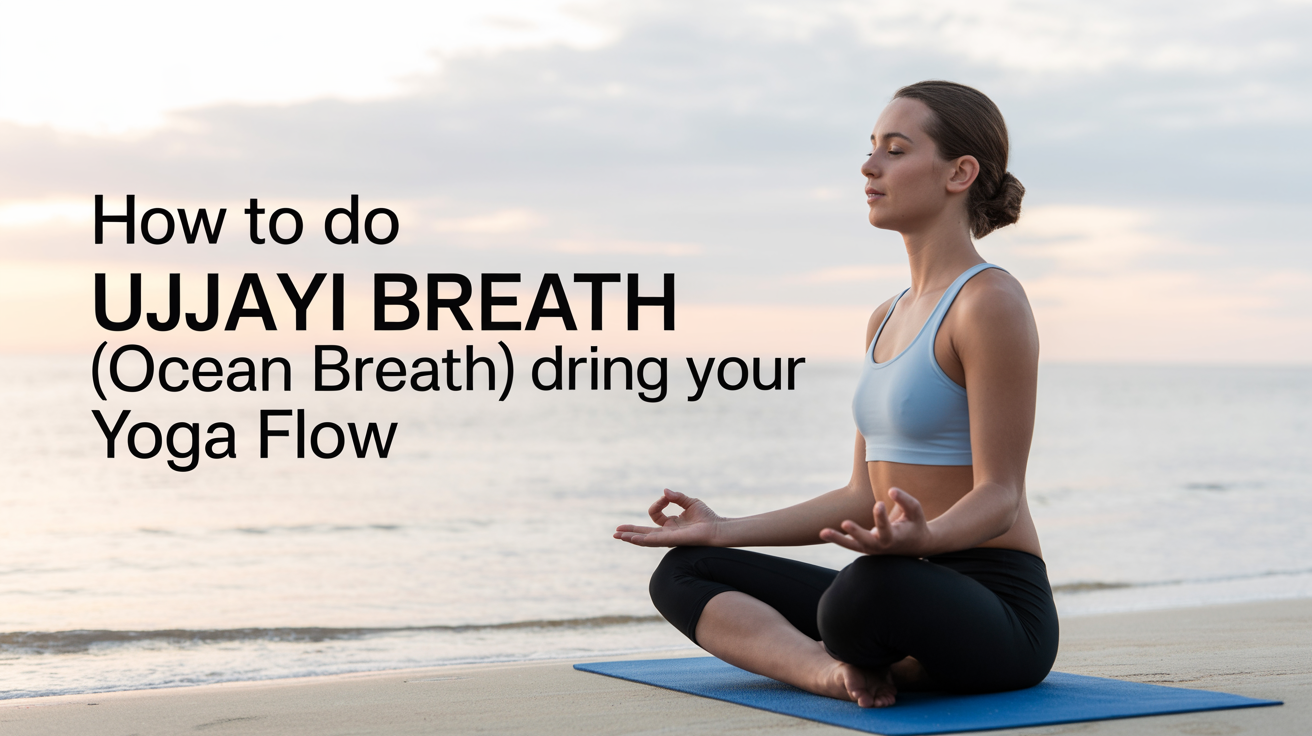
If you have ever taken a vinyasa class and heard a soft, rhythmic hissing sound moving through the room, that was probably ujjayi breath. Learning how to do ujjayi breath is one of the first "technique" skills a lot of beginners pick up, and it trips people up more than it should, mostly because teachers describe it in ways that sound mystical instead of mechanical. It is a small, learnable adjustment at the back of your throat that changes how your breath sounds and how your movement feels.
This guide covers what ujjayi actually is, how to find the sensation on your own, why it gets cued so often during flowing sequences, and the mistakes that make people give up on it before it clicks.
What ujjayi breath actually is
Ujjayi (pronounced oo-JAI-ee) translates loosely to "victorious" breath, which is why you will sometimes hear it called victorious breath instead of ocean breath. Both names point at the same thing: a breathing technique where you narrow the space at the back of your throat, near the glottis, just enough to create friction as air moves past it. That friction produces the sound, a soft, even rushing noise a lot of people compare to ocean waves or to Darth Vader breathing through a snorkel.
The key detail that separates ujjayi from just breathing loudly through your mouth is that it happens entirely through the nose, on both inhale and exhale, with your mouth closed the whole time. The sound comes from the throat constriction, not from moving more air. In fact, ujjayi tends to slow the breath down, because that narrowed opening acts like a small valve that regulates how quickly air can pass, the same muscles at work when you fog up a mirror or sigh through a slightly closed throat, just held steady across full breaths instead of one exhale.
Step-by-step: finding the ujjayi sound
Most people cannot get the ujjayi sound by simply being told "constrict your throat," because most of us have never had a reason to notice that muscle before. It helps far more to find it through a shape you already know: the sigh, or a fogging exhale.
- Start seated or standing, breathing normally through your nose. Just notice your breath for a few rounds before changing anything.
- Open your mouth and exhale like you are fogging up a window. Say a soft "haaa" as the air leaves, the way you might if wiping a lens clean. You should feel a slight catch or narrowing at the back of your throat.
- Repeat that fogging exhale two or three times, noticing where in your throat that sensation happens, usually near where your throat meets the back of your tongue and soft palate.
- Close your mouth and exhale through your nose while keeping that same throat shape. The air leaves through your nostrils, but the work still happens at the back of your throat. This is usually the moment people first hear the ocean sound through the nose.
- Try it on the inhale too. Beginners tend to skip this part. Keep the same gentle narrowing on the inhale; that sound is typically quieter than the exhale, and that is normal.
- String a few full breaths together, inhale and exhale, both through the nose, both carrying that same soft sound. Keep the pace slow and even rather than rushing to make the sound louder.
Some people find it faster to start from a whisper: silently mouth "haaa" with your mouth closed and see if that shape alone produces the sound once you breathe through your nose. Whichever route gets you there, the goal is the same, a steady, whispery hiss on both directions of the breath, made without opening your mouth.
If you have not spent much time with breathwork in general, it can help to back up to a simple introduction to pranayama first, since ujjayi sits on top of the same basic nose-breathing foundation as most other beginner techniques.
Why teachers cue it during vinyasa
Ujjayi shows up constantly in vinyasa and flow-style classes for a few practical reasons that have nothing to do with mysticism.
First, it gives you an audible pace-keeper. A vinyasa class links one movement to one breath, moving from downward dog to plank on an inhale, say, or folding forward on an exhale. That link only works if your breath has a length you can plan around, and ujjayi's narrowed airway naturally slows and evens out your breathing so an inhale can stretch to match a lift into a pose, or an exhale can stretch through a slow fold. Without that regulation, beginners tend to either race through poses trying to keep up, or hold their breath during a hard transition, the opposite of what a flow practice is going for.
Second, the sound gives you, and sometimes your teacher, feedback in real time. A choppy sound, or one that turns into open-mouth panting, usually means you have moved past a pace your breath can sustain, a cue to slow down rather than push harder. In a full room, a teacher can often hear when the whole class's breathing has gotten ragged, which tells them the sequence moved too fast.
Third, the sound itself is genuinely calming for a lot of people, the way a heartbeat or a fan running in the background can be. It gives the mind something steady to rest on, part of why ujjayi shows up in seated pranayama as well as in movement. For more on how breath and movement sync up beat for beat, see vinyasa basics for linking breath to movement.
Common beginner mistakes
Forcing the volume. The most frequent mistake is treating "louder" as "more correct." A loud, forced ujjayi usually means you are constricting too hard or pushing air with your belly and chest rather than letting the throat do the small amount of work required. The sound should be soft enough that only you, or someone sitting close to you, can hear it.
Straining the throat. If your throat feels tight, sore, or scratchy after a few minutes, you are gripping too hard. Ujjayi should feel like a gentle narrowing, not a squeeze, and never like you are starting to cough or gag. Back off the constriction until the sound gets quieter and the throat feels neutral again.
Trying to hold it through a difficult pose no matter what. It is normal for the sound to get uneven or briefly drop out during a genuinely hard hold, like a long plank. Reset it on your next easier breath rather than clenching your throat to force consistency.
Skipping the inhale. Because the exhale is where most people first feel the sensation, it is common to only apply ujjayi on the out-breath. That is a fine stepping stone, but the inhale is often what actually helps you find length and control going into a pose.
Confusing it with breathing faster. Ujjayi is not about moving more air quickly; the narrowed throat should slow your breath rate down. Breathing that speeds up while you add the ocean sound usually means tension, not technique.
If controlling your breath still feels foreign, spend time with plain, unconstricted diaphragmatic belly breathing first. Getting comfortable with a full, low breath makes the throat adjustment of ujjayi easier to layer on top of later.
Bringing it into your practice slowly
You do not need ujjayi on day one, and plenty of beginner classes will not mention it for the first several sessions. Practice the throat shape seated and still, away from any poses, until the sound comes without much thought. Then add it only to your sun salutations, since those have a clear, repeated inhale-exhale pattern that is forgiving to practice on, and it tends to carry into the rest of a flow from there on its own.
The technique is meant to support your practice, not become a performance in itself. If a pose or a day leaves you breathing hard through your mouth instead, that is fine. Ujjayi will still be there the next time your breath has room for it.
Frequently Asked Questions
Is ujjayi breath the same as ocean breath or victorious breath?
Yes. Ujjayi, ocean breath, and victorious breath all name the same technique: nasal breathing with a slight throat constriction that produces a soft, wave-like sound on both the inhale and exhale.
Should I use ujjayi breath during every yoga practice?
Not necessarily. It is most useful in flowing, vinyasa-style sequences and in seated pranayama or meditation work. In a slow, restorative, or yin-style practice, normal quiet nasal breathing is usually more appropriate, and forcing ujjayi there can add unnecessary tension.
Why does my throat hurt after practicing ujjayi breath?
Throat soreness almost always means the constriction is too tight or the volume is being forced. Ease off until the sound gets quieter and softer, and stop if discomfort continues. Ujjayi should never feel like straining or gagging; if it does consistently, check your technique with an in-person teacher rather than pushing through pain.
Can beginners learn ujjayi breath without a teacher?
Many people do, using the fogging-exhale method above as a stepping stone. That said, breath sensation is hard to self-correct from written instructions alone, so if it is not clicking after a few sessions, a class where a teacher can listen to your breath is genuinely useful.
Does ujjayi breath actually calm the nervous system?
The slower, more even breathing pattern ujjayi encourages is broadly consistent with breathing practices associated with a calmer physiological state. This is general wellness guidance, not medical advice, and it is not a treatment for anxiety or respiratory conditions; check with a qualified professional if you have a health condition affecting your breathing.