How to Link Breath to Movement in Yoga (Vinyasa Basics)
Learn how to link breath to movement in yoga with simple vinyasa basics, beginner cues, and ujjayi breathing tips to keep your flow calm and steady.
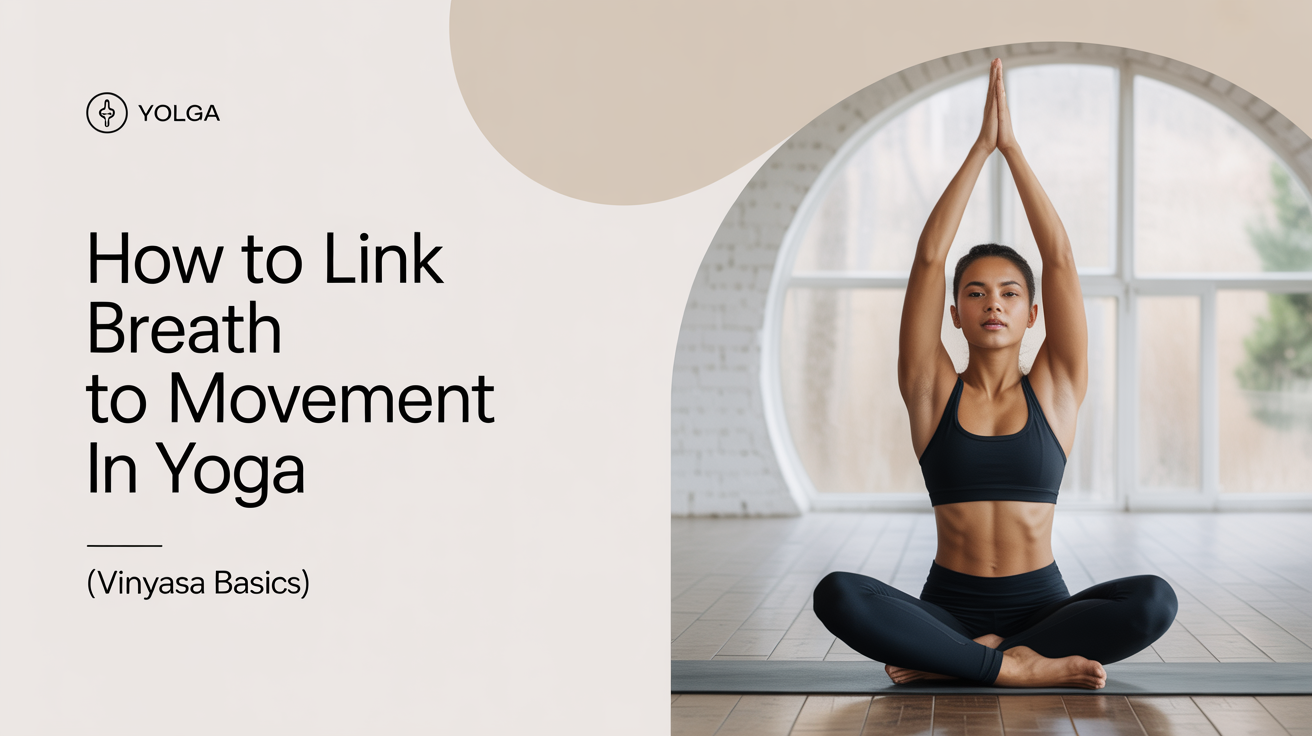
In a vinyasa class, the teacher keeps saying things like "inhale, reach up" and "exhale, fold forward." That pairing of one breath to one movement is the whole idea behind flow yoga. Once it clicks, your practice stops feeling like a list of poses and starts feeling like one long, connected motion.
If you have never tried it, linking breath to movement can seem like rubbing your stomach and patting your head. The good news is that it follows a simple logic, and your body already wants to do it. Here is how to make it work.
The Basic Rule: Inhale to Open, Exhale to Fold
Most of the time, the breath follows your body in a predictable way. Reaching, lifting, and opening the chest tend to happen on an inhale. Folding, twisting, and lowering tend to happen on an exhale.
Think about what your lungs are doing. When you breathe in, your ribs expand and your spine naturally wants to lengthen, so reaching upward feels right. When you breathe out, your front body softens and it gets easier to fold over your legs or rotate into a twist.
Here is the pattern in plain terms:
- Inhale: lift the arms overhead, lengthen the spine, lift the chest, arch gently into a backbend.
- Exhale: fold forward, twist, step or jump back, lower down toward the floor.
You do not need to memorize a rulebook. If you ever forget which breath goes with a movement, ask whether the pose opens your front body (inhale) or closes it (exhale). That single question covers most of what you will meet in a beginner flow.
Slow the Breath Down First
Before you worry about matching breath to poses, get comfortable with a slow, even breath while sitting still. Most beginners breathe too fast for flow, then run out of air halfway through a movement.
Try this for a minute right now. Breathe in through your nose for a count of four. Breathe out through your nose for a count of four. Keep both halves the same length. That steady, four-count rhythm is the pace you want to bring into your movement.
When you start flowing, your job is to make the movement last exactly as long as the breath. If your inhale takes four seconds, your arms should take four seconds to float up, not one quick second followed by three seconds of waiting. The breath sets the speed. The body matches it.
Add Ujjayi Breathing
Once the four-count rhythm feels natural, you can add the soft ocean sound that vinyasa is known for. This is called ujjayi breath, and an ujjayi breathing flow gives you something to hear and follow when your mind wanders.
To find it, open your mouth and exhale as if you were fogging up a mirror or a pair of glasses. Notice the gentle hush at the back of your throat. Now keep that same throat shape but close your mouth and breathe through your nose. You should hear a quiet, steady whisper, a little like distant waves or the sound inside a seashell.
A few cues that help:
- Keep it soft. It should be audible to you, not loud enough to startle the person on the next mat.
- Use it on both the inhale and the exhale.
- If it makes your throat sore or tight, you are forcing it. Back off and let it be gentle.
The sound becomes your metronome. As long as you can hear a smooth, unbroken breath, you know you are moving at the right pace. The moment the sound gets choppy or stops, that is your signal that you are rushing or holding your breath.
A Simple Sequence to Practice the Link
The classic place to practice breath and movement yoga is the sun salutation, because every step has a clear breath attached to it. Here is a short, beginner-friendly version you can repeat a few times.
| Breath | Movement | What it feels like |
|---|---|---|
| Inhale | Reach both arms up overhead | Tall and light through the spine |
| Exhale | Fold forward over your legs, soft knees | A release down the back of the body |
| Inhale | Lift halfway, flat back, hands on shins | Long spine, gaze a few feet ahead |
| Exhale | Step back to a plank, then lower your knees and chest | Steady and controlled, not a flop |
| Inhale | Slide forward into a gentle low cobra | Chest opening, shoulders down |
| Exhale | Press back to a downward dog | Hips lifting up and back |
Take five slow breaths in downward dog, then step forward and rise back up on an inhale. That is one round. Move through it three to five times.
If you want the full step-by-step breakdown of this shape, the beginner sun salutation guide walks through each pose in detail. When that feels smooth, the slightly longer Surya Namaskar B sequence adds a chair pose and a lunge so you can keep building.
Common Beginner Mistakes
Linking breath to movement trips people up in a handful of predictable ways. Spotting these early saves a lot of frustration.
Holding your breath during the hard part. When a pose gets challenging, the instinct is to clench and stop breathing. Do the opposite. The breath should be the last thing you let go of. If you catch yourself holding it, that is a cue to ease off the pose, not push harder.
Moving faster than you breathe. Beginners often race ahead and finish the movement while still mid-inhale. Let the breath lead and the body follow, even if that means slowing way down.
Forcing a deep stretch to "keep up." Flow is not a competition. Bend your knees in a forward fold, take a smaller backbend, skip the jump and step instead. A flow done within your range, with a calm breath, beats a deep one with ragged gasping every time.
Move gently, never force a stretch, and come out of anything that gives you sharp or pinching pain right away. This is general education, not medical advice, so check with a doctor first if you are pregnant, recovering from an injury, or managing a health condition.
Putting It Together
You do not need to nail all of this at once. Start by sitting and slowing your breath. Add the inhale-to-open, exhale-to-fold rule. Layer in ujjayi when the rhythm feels steady. Then practice with a sun salutation until the breath is driving the whole thing.
Vinyasa for beginners really does come down to patience with this one skill. If you want a low-pressure place to rehearse it, try a gentle ten-minute morning flow where the pace is slow enough to actually feel each breath move you. Some days the connection will feel obvious. Other days your mind will wander and the breath will get choppy. That is normal. Notice it, slow down, and pick the thread back up.
FAQ
What does "vinyasa" actually mean?
In modern yoga classes, vinyasa usually refers to a style where you move from pose to pose in time with your breath, rather than holding each pose for a long stretch. It also describes the specific plank-to-cobra-to-downward-dog transition you repeat between sequences.
Should I breathe through my nose or my mouth?
For flow yoga, breathe in and out through your nose whenever you can. Nose breathing keeps the breath slower and steadier, which is exactly what you want for a smooth flow. If you get winded and need to gulp some air through your mouth, that is fine, just return to nose breathing when you can.
What if I run out of breath before the movement is finished?
That means the movement is too slow for your current breath, or the breath is too short for the movement. Shorten the range of the pose, or simply take an extra breath. It is completely fine to add a breath anywhere. The goal is a calm, connected feeling, not rigid one-breath-per-pose perfection.
How long until linking breath to movement feels natural?
Most people feel it start to click within a few weeks of regular practice, even just ten minutes a few times a week. The sun salutation is the fastest way to get there because the breath cues are so clear and you repeat them often.
Is ujjayi breathing required for vinyasa?
No. Ujjayi is a helpful tool because the sound gives you a rhythm to follow, but a quiet, even nose breath works perfectly well. Learn the breath-to-movement link first, then add ujjayi once you are ready.