Yoga for Complete Beginners: What to Expect at Your First Session
New to yoga? Here is exactly what happens in your first class, what to bring, common worries, and how to feel comfortable as a total beginner.
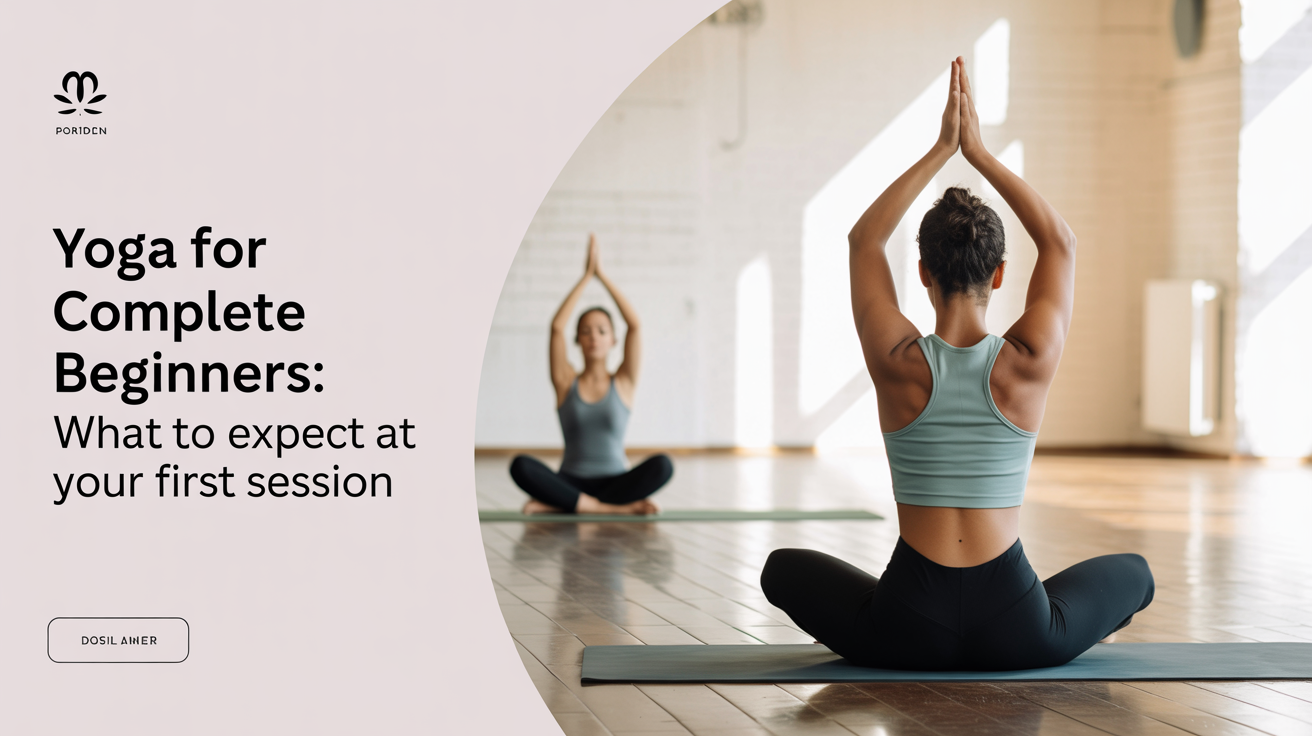
If you have never set foot on a yoga mat, the first class can feel a little intimidating. You picture a room full of bendy people folding themselves into pretzels while you sit there unable to touch your toes. Here is the honest truth: nobody is watching you, almost everyone was a stiff, nervous beginner once, and you do not need any flexibility to start.
This guide walks you through what actually happens at a first session, start to finish, so you can show up knowing roughly what is coming. The unfamiliar part is usually the only scary part.
Is yoga good for beginners?
Short answer: yes. Yoga is one of the few movement practices built to meet you exactly where you are. Every pose has an easier version, and a good teacher will offer those options out loud as the class goes.
You do not need to be flexible to begin. Flexibility is a result of practicing, not a requirement to start. The same goes for strength and balance. If you can breathe and move a little, you can do a beginner class.
A few things yoga tends to help with for new people:
- Tight hips and a stiff lower back from sitting all day
- Stress and a racing mind, especially in the evening
- Body awareness, so you start to notice when you are clenching your shoulders
- Gentle, low-impact strength without heavy weights
If you are pregnant, recovering from an injury, or managing a health condition, have a quick word with your doctor before you start, and tell the teacher when you arrive. This is general guidance, not medical advice, and one honest sentence to your instructor goes a long way.
Before you go: a few simple decisions
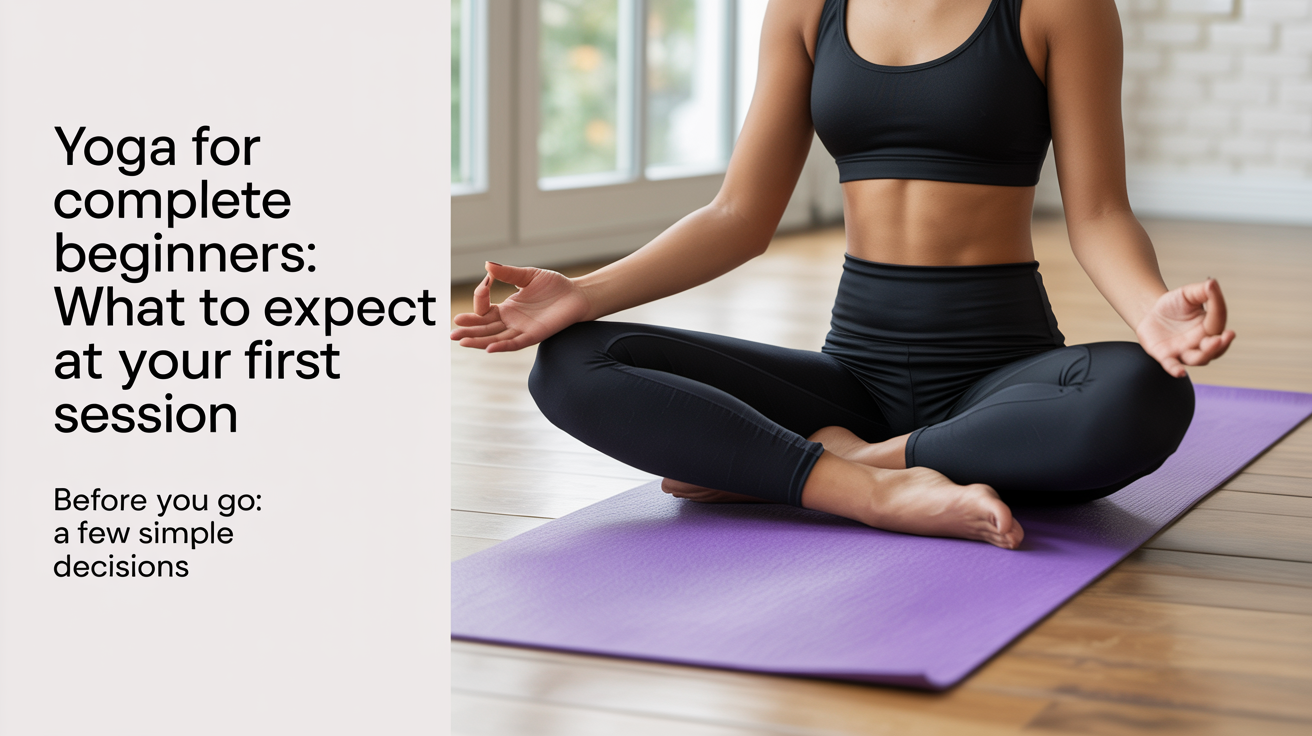
You can overthink this. Most beginners do. The reality is that a first class needs very little from you.
What to wear: anything stretchy you can move and sweat lightly in. Leggings or shorts, a top that will not fall over your head when you bend forward. No shoes, no socks (bare feet grip better). If you want a full rundown, our guide on what to wear and bring to your first yoga class covers the small details.
A mat: most studios lend or rent mats, so you do not have to buy one to try a class. If you catch the bug and want your own, how to choose a beginner yoga mat breaks down thickness and grip without the jargon.
Eating: leave roughly two hours after a full meal. A heavy stomach and forward folds do not mix well.
Arrive early: get there 10 to 15 minutes ahead. You can set up, tell the teacher you are new, and settle your nerves instead of rushing in flustered.
What a beginner yoga first time actually looks like
Here is the rough shape of a typical 60-minute beginner or "gentle flow" class. Times vary, but the structure is usually similar.
| Phase | Roughly how long | What happens |
|---|---|---|
| Settling in | 5 min | Sit or lie down, slow breathing, set an intention |
| Warm-up | 10 min | Gentle stretches, cat-cow, easy neck and shoulder rolls |
| Standing poses | 20 min | Mountain, forward fold, warrior shapes, balance work |
| Floor work | 15 min | Seated stretches, twists, hip openers, gentle backbends |
| Final rest | 5–10 min | Savasana: lying still on your back, fully relaxed |
That last part, savasana, surprises a lot of newcomers. You lie completely still and do nothing for several minutes. It feels strange at first and becomes the bit most people end up loving.
The breathing thing
Teachers talk about the breath constantly. "Inhale, reach up. Exhale, fold." Do not stress about syncing it perfectly. The one rule that matters: never hold your breath. If you notice you are holding it during a tough pose, that is your signal to ease off. Steady breathing keeps you calm and tells you when you are overdoing it.
What it feels like, and where beginners get it wrong
Some poses will feel awkward. Your forward fold might reach mid-shin instead of the floor, and that is completely fine. Bend your knees as much as you need.
A handful of mistakes show up in nearly every first yoga class. Knowing them ahead of time helps:
- Pushing into pain. A good stretch feels like a strong, dull pull. Sharp, pinching, or burning pain means back off now. Pain is not progress.
- Comparing yourself to the room. The person beside you may have practiced for years. Keep your eyes on your own mat.
- Skipping the modifications. When the teacher says "drop to your knees if you need to," they mean you. Take the easier option freely.
- Forgetting to breathe. Covered above, but it is the most common one by far.
- Locking your joints. Keep a soft, micro-bend in your knees and elbows rather than jamming them straight.
If something in a pose causes sharp or pinching pain, come out of it slowly and rest in a neutral position. No teacher will mind. They would much rather you protect yourself than push through.
For the bigger picture of building a routine after this first class, our complete beginner's guide to starting yoga maps out the next few weeks.
Quieting the nerves
Most first-timer worries are louder in your head than in the room. Here are the usual ones, answered plainly.
- "Everyone will see how inflexible I am." They are looking at their own mat and their own balance. Honestly, they are not watching you.
- "I won't know the pose names." You follow the teacher and the people around you. Sanskrit names wash over you for the first few months, and that is normal.
- "What if I fall over in a balance pose?" You will wobble. Everyone wobbles. Wobbling is the balance practice working.
- "What if I need to rest mid-class?" Drop into child's pose (knees down, hips back toward heels, forehead toward the mat) any time. It is the universal "I need a moment" pose, and using it is a sign of a smart practitioner, not a quitter.
Give yourself permission to be a beginner. You are allowed to be new at this.
FAQ
Do I need to be flexible before my first yoga class?
No. This is the single biggest myth. You build flexibility by practicing, so showing up stiff is exactly the right starting point. Bend your knees, use props, and let your range grow over weeks.
How often should a complete beginner do yoga?
Two or three sessions a week is plenty to start. Even one consistent class a week beats an ambitious plan you abandon. Consistency matters far more than intensity in the early going.
Will I be sore after my first session?
Possibly, in a mild way, especially through your hips, hamstrings, and core. That is normal muscle adaptation. If you feel sharp joint pain rather than general muscle soreness, that is different, and worth easing back on next time.
What style of yoga is best for a beginner?
Look for classes labeled "beginner," "gentle," "hatha," or "slow flow." These move at a manageable pace with clear instruction. Avoid hot yoga or fast power classes until you have a few sessions under your belt.
What if I can't do a pose at all?
Then you do the version you can, or you rest. Every pose has a scaled-down option, and resting in child's pose is always a valid choice. Doing the modified version fully beats forcing the full version badly.