Yoga Nidra for Beginners: How to Try This Deep Rest Practice
Yoga nidra is a guided body-scan practice done lying down. Learn what it is, what a session involves, and how to set up comfortably at home.
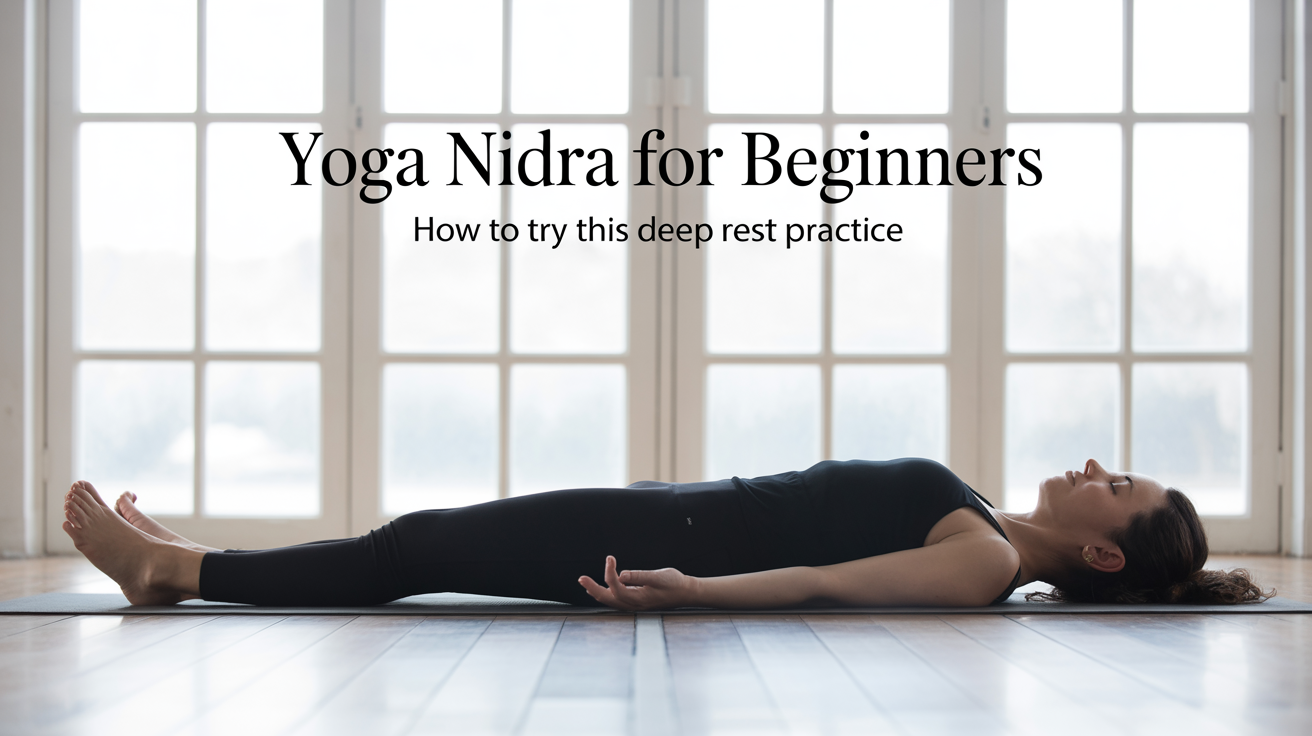
Yoga nidra is sometimes called yogic sleep, but that name can be a little misleading. You are not trying to fall asleep, and you are not meditating in the usual sense. You lie down, stay still, and follow a recorded or live voice that moves your attention through different parts of your body and layers of experience. The result, for many practitioners, is a quality of rest that feels distinct from both a nap and a seated meditation.
No poses are involved. No flexibility is required. If you can lie flat on your back and listen, you have everything you need to try it.
What Yoga Nidra Actually Is
Traditional yoga nidra comes from the Tantric tradition and was systematized in the 20th century by Swami Satyananda Saraswati. The word nidra means sleep in Sanskrit, but the practice aims for a threshold state between waking and sleeping, not unconsciousness.
During a session, you stay awake enough to follow instructions while allowing your body to become deeply relaxed. Your attention is guided rather than self-directed, which is what separates it from most forms of meditation where you manage your own focus. The guide does the heavy lifting; your job is simply to follow along without forcing anything.
A session typically moves through several stages: settling into your body, setting a short personal intention (called a sankalpa), rotating attention through body parts, working with pairs of opposite sensations, and then gradually returning to full wakefulness. Different teachers and recordings use slightly different sequences, so two sessions can feel quite different even if both are called yoga nidra.
Many practitioners find the practice leaves them feeling more refreshed than a comparable amount of ordinary rest. That said, experiences vary, and results are not guaranteed. The practice is worth trying on its own merits, not for any promised outcome.
How a Typical 10 to 15 Minute Session Unfolds
A short beginner session generally follows this arc:
Settling in. You arrive in your position and the guide invites you to become aware of the room, sounds, and the surface beneath you. This is not about achieving silence or stillness. You simply notice what is already here.
Sankalpa. A sankalpa is a brief intention or resolve, usually a short phrase that feels personally meaningful. You repeat it internally three times at the beginning and end of the session. For a beginner, this step is optional. You can skip it entirely until the concept feels relevant.
Body rotation. The guide names body parts in a specific sequence, typically moving around one hand, up the arm, across the face, down the torso, around the other arm, and then down each leg. You move your attention to each area as it is named, staying only a second or two before moving on. The pace is the key feature here. It is fast enough to keep your attention moving but slow enough that the body begins to release held tension.
Opposite sensations. The guide may ask you to briefly feel heaviness, then lightness; warmth, then coolness. This is not an imagination exercise so much as a scanning of actual physical sensation. If you cannot feel what is named, simply stay with what you can notice and let the instruction pass.
Return. The guide brings awareness back to the breath, the room, and the body as a whole. Fingers and toes are gently moved. Eyes open when ready.
That is the basic structure. A 10-minute session contains the same ingredients as a 30-minute one, just with less time in each stage.
Setting Up a Comfortable Position at Home
The standard position for yoga nidra is savasana: lying on your back, arms slightly away from your sides, palms facing up. If you want more guidance on settling into that shape, how to actually rest in savasana, corpse pose covers the details.
The main challenge for new practitioners is physical discomfort that interrupts the session. A few simple props address the most common issues:
Lower back tension. Place a rolled blanket or bolster under your knees. This takes the pull off the lumbar spine and makes lying flat sustainable for longer.
Head and neck. A thin folded blanket under the head is usually enough. The goal is a neutral neck, not the head pushed forward by a thick pillow.
Temperature. Lying still causes body temperature to drop noticeably within a few minutes. Have a light blanket ready to pull over yourself before you begin. Stopping to find one mid-session breaks the continuity.
Eyes. An eye pillow gently blocks light and adds slight pressure that many people find settling. A folded cloth works just as well. Neither is required.
Sound. Use headphones if your space has background noise. The guide's voice is the anchor for the practice, so being able to hear it clearly matters more than having a perfectly quiet room.
If lying flat is uncomfortable due to injury or pregnancy, a reclined position on a wedge pillow or propped against a wall is a reasonable starting point. As with any new practice, check with your doctor before beginning if you are pregnant, recovering from an injury, or managing a health condition. Your body's feedback is the most reliable guide for what adjustments to make.
How Yoga Nidra Differs from Meditation and Sleep
New practitioners often wonder how this practice relates to sitting meditation. The difference is primarily in posture and the role of the guide. In most seated meditation, you observe your own mind and work to stabilize attention independently. Yoga nidra provides an external voice to follow, which many people find easier when they are just starting to practice stillness. There is no wrong way for the mind to respond, because the guide keeps moving the session forward regardless.
It also differs from sleep because the aim is to remain aware throughout. Most people do drift into actual sleep occasionally, especially early on. That is not a failure. Over time, many practitioners find they can stay at the threshold without crossing it, but that comes with repetition rather than effort. For a complementary approach to working with the breath before sleep, a short bedtime breathing routine for better sleep offers a simple practice that can pair well with nidra.
If you are curious about seated practice, how to meditate for beginners: a simple starting point explains how to build a basic sitting practice alongside or separately from yoga nidra.
Frequently Asked Questions
Do I need any experience with yoga to try yoga nidra? No. Yoga nidra requires no poses, no flexibility, and no prior experience with any form of yoga or meditation. The only requirement is the ability to lie down and listen.
What if I fall asleep during the session? It happens, especially in the early stages. Rather than fighting it, notice it when you wake up and return your attention to the guide's voice. Sleep during yoga nidra is not the goal, but it is also not a problem to solve. With practice, the boundary between rest and sleep often becomes easier to find.
How long should a beginner session be? Ten to fifteen minutes is a reasonable starting point. Sessions that length include all the core stages without demanding an extended commitment. Many practitioners stick with that range indefinitely and find it sufficient.
Can I practice yoga nidra every day? Many teachers suggest daily practice, at least in the beginning, because the effects tend to be cumulative. That said, any frequency you can sustain consistently is more valuable than a schedule you cannot keep.
Are guided recordings necessary, or can I practice without one? For most beginners, a recording is genuinely helpful. The external guidance removes the need to remember the sequence, which keeps the practice restful rather than effortful. Free recordings are widely available from yoga schools and apps. Once the structure becomes familiar, some practitioners use self-guided sessions, but the recorded format suits most people indefinitely.