How to Modify Plank and Chaturanga in a Flow
Learn how to modify chaturanga for beginners with knees-down options that protect your shoulders and wrists during a sun salutation flow.
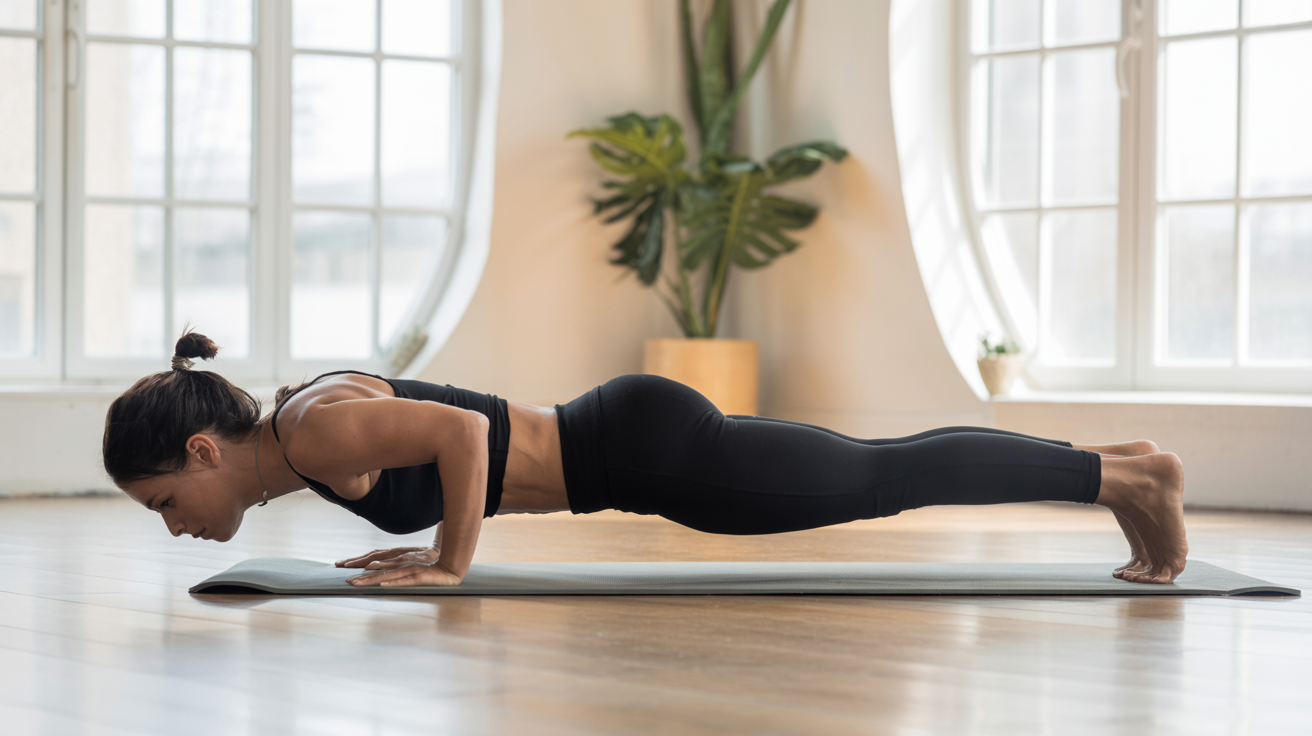
Chaturanga Dandasana gets a reputation as the hardest part of a sun salutation. In a led class, the sequence moves fast, and beginners often end up collapsing through the shoulders or skipping the pose entirely. The good news: there is a set of simple modifications that let you build the shape at your own pace, protect your joints, and still get a real workout. You do not need to do the full version to benefit from the practice.
Why Beginners Struggle with Chaturanga
Chaturanga asks your triceps, shoulders, and core to lower your entire body weight in a slow, controlled line from plank to a few inches above the floor. That is a significant demand, especially when you are new to the sequence.
Common problems beginners run into:
- Shoulders dip below the elbows, which puts the rotator cuff under strain
- Elbows splay outward instead of tracking back along the ribs
- The lower back sags because the core has not yet learned to stay engaged
- Wrists ache under the load before the arms are strong enough to share it
None of this means you are doing yoga wrong. It means you are building toward the pose, which is exactly what a modification is for.
The Knees-Down Modification for Plank
Before you can safely lower into chaturanga, you need to be stable in plank. The knees-down version gives you that stability while cutting roughly half the load.
How to set it up:
- Start on all fours with wrists under shoulders and knees under hips.
- Walk the hands forward a few inches and lower the hips until your body forms a diagonal line from knees to crown.
- Tuck the toes or leave the tops of the feet on the mat, depending on what feels more comfortable.
- Spread the fingers wide and press into the base of every knuckle, not just the heel of the hand.
- Draw the low belly gently in and keep the hips level, not lifted toward the ceiling.
Hold here for a few breaths. If your wrists ache even in this position, fold the front edge of your mat to create a small wedge under the palms, or try resting on your forearms instead.
The Knees-Down Chaturanga
Once you are steady in knees-down plank, you can practice the lowering action of chaturanga with much more control.
Step by step:
- From knees-down plank, inhale to reset your alignment.
- On the exhale, keep the elbows tucked close to the ribs and bend them backward, not out to the sides.
- Lower slowly until your chest is a few inches above the floor or until you feel your core beginning to lose its engagement, whichever comes first.
- Pause there for a breath if you can.
- Press into the palms, straighten the arms, and come back up to knees-down plank, or let the chest and thighs land on the mat and continue to upward-facing dog or a simple cobra.
The key detail: elbows stay hugged in. If they splay, slow down and lower only as far as you can maintain that position.
How This Fits Into a Sun Salutation
In a sun salutation for beginners, chaturanga appears after a forward fold and a step or jump back to plank. In the knees-down version, the sequence looks like this:
- Step back to knees-down plank (or lower the knees after stepping back)
- Exhale into knees-down chaturanga
- Inhale to cobra or knees-down upward dog
- Exhale to downward-facing dog
With time, you can start experimenting with one leg extended in full plank while the other knee stays down. This is a useful midpoint before moving to the complete version.
Using Props to Support the Transition
Props are not a workaround; they are part of intelligent practice.
| Prop | How it helps |
|---|---|
| Folded blanket or block under the chest | Gives your chest a target so you can feel the right height for chaturanga |
| Rolled mat or wedge under the wrists | Reduces wrist extension and pressure |
| Yoga strap looped above the elbows | Trains elbows to stay tucked without having to think about it |
| Yoga block under the thighs | Lets you practice hovering just above the floor with support |
A block placed lengthwise under the chest is especially useful. Lower until the sternum grazes it, then press back up. You train the lowering and pressing action without the risk of collapsing.
When to Stay with the Modification
There is no timeline for moving to the full chaturanga. Staying with the knees-down version for months is a legitimate choice, not a failure. Some signals that the modification is doing its job:
- You can lower slowly and with control rather than dropping
- Your elbows consistently track back, not out
- You feel the work in your triceps and the sides of your chest, not your neck or wrists
Some signals to move more carefully or check with a teacher:
- Sharp or pinching sensation in the shoulder or wrist
- Numbness or tingling in the hands
- Lower back pain during or after practice
If you are pregnant, recovering from a shoulder or wrist injury, or managing a health condition, talk with a doctor or physical therapist before working on weight-bearing arm poses. Listening to what your body is telling you on any given day is more useful than following a fixed progression.
Pair this work with a consistent breath practice. Learning to link breath to movement in yoga gives you a natural rhythm for the lowering and pressing action, and it keeps the pace slow enough to maintain form.
Progressing from Modification to Full Chaturanga
When you feel ready to explore the full version, treat it as an experiment rather than a goal you have to hit.
A useful drill: set up in full plank (knees off the floor), and lower ONLY two or three inches before pressing back up. Do not aim for the floor. You are training the first part of the movement, which is where most beginners lose alignment.
Over time, increase the range of motion by a centimeter at a time. You can also practice against a wall: stand facing the wall, place your hands on it at chest height, and practice the bending and pressing action while standing. This version takes body weight almost entirely out of the equation and lets you feel the mechanics clearly.
As you build toward the full vinyasa, Surya Namaskar B introduces the chaturanga transition at a slightly different pace, which some beginners find easier to coordinate than Surya A.
Frequently Asked Questions
Is knees-down chaturanga a real chaturanga?
Yes. Knees-down chaturanga works the same muscle groups as the full version and teaches the same alignment principles. The load is lighter, which is the point when you are building strength. Many experienced practitioners use it intentionally during recovery or on days when the full version would strain an existing injury.
My wrists hurt in plank. What should I do?
Try spreading your fingers wider and pressing firmly into the base of each finger, not just the heel of the hand. If that does not help, use a folded mat under your palms for extra cushioning, or shift to fists (knuckles on the mat) to reduce wrist extension. Persistent wrist pain that does not improve with adjustments is worth discussing with a physical therapist before continuing.
How many rounds should I do before moving on?
There is no set number. Some people are comfortable in the full chaturanga after a few weeks; others take a year or more. Consistency matters more than speed. Practicing two or three sun salutations with good form in knees-down chaturanga is more valuable than forcing a full version that collapses at the bottom.
Can I mix modifications within the same practice?
Absolutely. Taking a knees-down chaturanga on one round and attempting the full version on the next is a sensible way to explore the transition. Many teachers encourage this approach because it keeps the practice safe while still challenging you to try new things.
What if I skip chaturanga and just lower all the way to the floor?
Sliding through to the floor is a valid option when you are tired or when your form is breaking down. The full sequence is designed to flow continuously, and honoring that rhythm sometimes means choosing the softer landing. Just be aware that lowering without control can put stress on the lower back over time, so building the strength to pause in the pose is worth working toward gradually.